Underquilt vs sleeping pad in a hammock is a decision every hammock camper eventually has to make once the weather turns cool enough that a bare hammock alone stops being comfortable, since the fabric of a hammock provides essentially no insulation against the cold air moving underneath and around your body once you lie on top of it. Both an underquilt, which hangs suspended beneath the hammock body, and a sleeping pad, which sits inside the hammock underneath the sleeper, solve the same underlying problem, but they do it through different mechanisms with different trade offs in comfort, weight, and cost.
This decision usually surfaces the first time a hanger camps somewhere cool enough to notice their sleeping bag is not keeping them warm, since a bag that feels perfectly adequate in a tent can leave a hammock camper genuinely cold on the same night at the same temperature. Understanding why that happens, and which fix actually addresses it, saves a lot of trial and error compared to simply buying a warmer bag and hoping the problem goes away.
The short answer
Choose an underquilt if you want the most comfortable, best-performing insulation specifically designed for a hammock’s curved shape, and you are willing to pay more for it. Choose a sleeping pad if you already own one for other trips, want a dual-purpose piece of gear, or are on a tighter budget. Most dedicated hammock campers eventually move to an underquilt, while occasional or budget-conscious hangers often stick with a pad they already own.
Side by side
| Factor | Underquilt | Sleeping pad |
|---|---|---|
| Insulation mechanism | Hangs beneath, never compresses | Sits inside, compresses under body weight |
| Typical weight (3 season) | Roughly 18 to 24 oz | Roughly 12 to 20 oz |
| Dual-purpose use | Hammock specific only | Also works in a tent |
| Typical price (3 season) | Often higher | Often lower or already owned |
| Shifting during the night | Stays fixed in place | Can shift or slide |
Underquilts explained

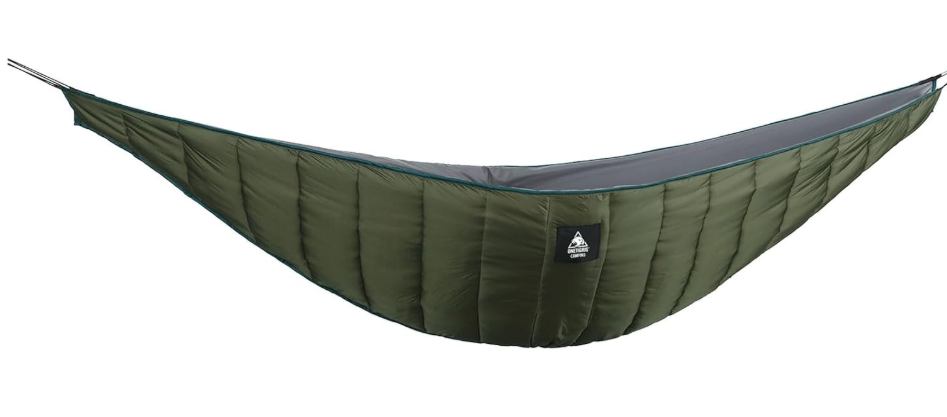
An underquilt hangs suspended underneath the hammock body via its own dedicated attachment points or carabiners at the head and foot end, so it never bears body weight the way insulation inside the hammock does. This matters because insulation works by trapping still air within its material, down plumes or synthetic fibers create pockets of air that resist heat transfer, and compressing that material flattens those air pockets, which is exactly what happens to a sleeping bag or pad the instant your body weight presses down on it from above.
Because an underquilt hangs freely below the hammock rather than being compressed against it, its full loft stays intact all night, delivering meaningfully better warmth per ounce of insulation than a compressed sleeping pad or sleeping bag bottom can. Most underquilts use a differential cut, meaning the outer shell is sewn larger than the inner shell, which lets the down loft outward around the hammock’s curve rather than getting pulled tight and thin, a detail that matters more than it might sound since a tight, thin quilt loses much of its trapped-air advantage.
Underquilts also typically attach at more points than a pad requires, head end, foot end, and sometimes along the sides via shock cord or webbing loops, which lets the hanger cinch the quilt snug against the hammock body and close off the convective air gaps that would otherwise let cold air flow underneath despite the insulation being technically present. A loosely hung underquilt with visible gaps performs noticeably worse than the same quilt properly cinched tight, which is why suspension adjustability matters almost as much as the insulation’s raw temperature rating.
Sleeping pads explained

A sleeping pad sits inside the hammock directly underneath the sleeper’s body, the same way it would inside a tent, using either closed-cell foam, self-inflating foam and air, or an air chamber to create a layer of insulation between the body and the hammock fabric. Because the pad is being compressed under body weight, its R-value, a standardized measure of resistance to heat flow, becomes the deciding factor, and a pad rated for reasonably cold temperatures can perform nearly as well as an underquilt in terms of raw warmth despite the compression.
The real drawback inside a hammock specifically, rather than a tent, is shape and stability, a hammock’s curved, non-flat surface makes a rectangular or slightly tapered pad prone to shifting, bunching, or leaving gaps at the shoulders and hips where cold air can reach the hammock fabric directly. Some campers address this with a wider pad or by combining a foam pad with the hammock’s natural cradle shape, but it rarely achieves the same consistent, gap-free coverage that a properly fitted underquilt delivers automatically.
Pad type also matters inside a hammock more than it does on flat ground, a rigid closed-cell foam pad tends to resist the hammock’s curve and can create pressure points or gaps at the edges, while an inflatable air pad conforms more easily to the curved shape but introduces its own risk, a puncture from a stick, zipper pull, or rough handling leaves the sleeper with no insulation at all until it can be patched, a failure mode an underquilt simply does not share.
Where each one wins
Comfort and warmth consistency
Underquilts win clearly, the suspended design avoids the shifting and gapping that a pad is prone to inside a hammock’s curved shape, delivering more consistent warmth across the whole night.
Price
Sleeping pads often win, particularly if you already own one from tent camping, since buying a dedicated underquilt is an additional purchase specifically for hammock use.
Dual-purpose value
Sleeping pads win decisively here, the same pad works in a tent, on a cot, or on the ground, while an underquilt is useful only when hanging in a hammock.
Interior room
Underquilts win, since they hang outside the hammock body entirely, leaving the full interior space free rather than taking up room inside the hammock the way a pad does.
Setup effort
Roughly comparable, though a pad needs periodic repositioning if it shifts during the night, while an underquilt, once properly hung, generally stays in place without adjustment.
Puncture risk
Underquilts win clearly, since an inflatable pad can lose all of its insulating value instantly if punctured by a stick, rough bark, or sharp gear, while a quilt’s soft fill insulation has no comparable single point of failure.
Which should you buy
If you are committed to hammock camping as your primary shelter style and cool-weather comfort matters, a dedicated underquilt is worth the added cost for the consistent, gap-free warmth it delivers. If you already own a good sleeping pad from tent camping, or you are still deciding whether hammock camping suits you long term, using that pad first is a sensible, lower-cost way to extend your season before investing further. For the full range of hammocks and gear, see our camping hammock buying guide, and our best hammock underquilts roundup covers specific models.
Frequently Asked Questions
Can I use a sleeping pad and an underquilt together?
Yes, some hangers combine both for genuinely cold weather, the pad adds a bit of extra insulation and can also help with side-sleeping comfort, though for most three-season conditions an underquilt alone is sufficient without the added bulk of a pad as well.
Why does my sleeping bag feel cold in a hammock even though it is warm in a tent?
The insulation on the underside of the bag compresses flat under your body weight the instant you lie on it, whether in a tent or a hammock, but in a tent the ground itself and a pad underneath provide additional insulation, while a hammock’s thin fabric provides essentially none on its own.
Do pads slide around more in a hammock than in a tent?
Generally yes, since a hammock’s curved shape does not hold a flat rectangular pad in place the way a tent’s flat floor does, which is the main reason many hangers eventually switch to an underquilt for a more stable, consistent fit.
What temperature should I switch from a pad to an underquilt?
There is no universal cutoff, but many hangers find a pad adequate down to around 50 to 60 degrees Fahrenheit before the shifting and gapping issues become noticeable enough to make an underquilt worth the investment for consistently colder trips.
Buy a dedicated underquilt for the most consistent, gap-free hammock warmth, and rely on a sleeping pad you already own if budget or dual-purpose use matters more.