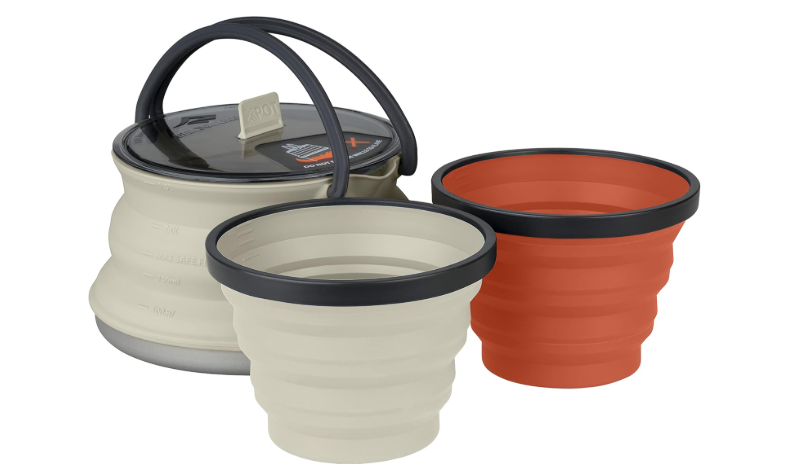
This sea to summit x-pot 2.8l review is for backpackers and bikepackers who have stared at a hard sided pot and wondered why it has to take up the same rigid, unsqueezable space in a pack whether it is full or empty. Sea to Summit solved that with the X-Pot line by building the pot walls from food grade flexible silicone around a hard anodized aluminum base, collapsing a pot that would normally eat a fixed amount of pack volume down to a fraction of its set up height.
What decides whether the X-Pot 2.8L suits you is how much you value that collapsed packing size against the slightly different handling and care a silicone walled pot asks for compared to a traditional rigid pot. If packed volume is a real constraint on your trips, whether that is a small bikepacking frame bag or a backpacking pack already stuffed with other gear, the X-Pot deserves a close look, and understanding how the hybrid silicone and aluminum construction actually performs at the stove is worth walking through before you build a kit around it.
Specifications
| Capacity | 2.8 liters |
| Construction | Silicone walls, hard anodized aluminum base |
| Collapsed height | Significantly shorter than set up height |
| Lid | Vented hard plastic lid, doubles as strainer |
| Handle type | Folding wire bail handle |
| Heat source compatibility | Camp stoves, not recommended for open flame on the silicone walls |
Who it is for
The X-Pot 2.8L suits backpackers, bikepackers, and anyone packing a small volume container where a traditional rigid pot of the same capacity simply will not fit, since the collapsible silicone walls let this pot shrink down to a footprint closer to a flattened cup than a full sized pot. It also suits group or family car campers who want a larger capacity pot for boiling pasta water or cooking for several people without it permanently occupying a large rigid space in a storage bin between trips, since it collapses flat enough to tuck into a much smaller gap on the shelf.
It is a weaker fit for anyone planning to cook directly over an open campfire or place the pot in direct contact with flame, since the silicone walls are rated for stove use rather than open flame exposure, and it is also a weaker fit for anyone who wants to sear or fry food in the same vessel, since the collapsible wall design and the pot’s intended use case are built around boiling rather than high heat frying. For boiling water, cooking pasta, or simmering a one pot backpacking meal, though, it is a strong, purpose built option.
How it performs
Collapsible design and packed volume
The core engineering idea behind the X-Pot is separating the pot’s structural walls from its heat conducting base. The base is hard anodized aluminum, rigid and solid in the same way a traditional pot bottom would be, while the walls are food grade silicone that fold down accordion style when the pot is not in use. This matters because pack volume, not just weight, is often the real constraint on a loaded backpacking trip or a small bikepacking frame bag, and a pot that can shrink to a fraction of its working height solves a space problem that a traditional rigid pot of the same capacity cannot.
The tradeoff for that collapsibility is that the pot does not nest other gear inside quite as cleanly as a fully rigid pot does when collapsed, since the folded silicone walls take up an irregular shape rather than a clean cylindrical gap, though most users still find a few small items, a stove, a lighter, a scouring pad, fit inside the collapsed pot without much trouble, keeping the overall kit compact even if the fit is not perfectly geometric.
Heat conduction at the aluminum base
Because only the base of the X-Pot is metal, all of the actual heat transfer into the food happens through that hard anodized aluminum disc, which conducts heat quickly and evenly in the same way a standalone aluminum pot would, a real advantage over a pot built with a thinner or lower quality base metal. Hard anodizing, an electrochemical process that thickens and hardens the aluminum’s surface oxide layer, also makes that base more scratch and pit resistant over repeated stove contact than untreated aluminum would be.
The practical effect of this base only heating is that boiling water or cooking anything liquid works essentially the same as it would in a fully rigid aluminum pot, since the silicone walls are simply along for the ride holding the contents in, not meaningfully involved in heat transfer. Where it differs from a fully rigid pot is in how carefully you need to manage flame size, since a flame that licks up past the base and onto the silicone walls is outside the pot’s intended operating range, so a moderate flame sized to the base diameter is the right approach rather than cranking a stove to maximum output.
Stability and handling while cooking
The folding wire bail handle is a simple, proven design for lifting a hot pot off a stove, though the pot’s flexible walls mean it handles slightly differently than a fully rigid pot when full, with a bit more give in the silicone sidewalls than you would feel gripping a hard aluminum or steel pot body directly. This is rarely an issue in practice since the bail handle is the actual lifting point, but it is worth being aware of if you are used to the completely rigid feel of traditional cookware.
On an uneven camp surface, the hard aluminum base still provides the same stable footing a traditional pot base would, since stability while simmering is determined by that rigid base contacting the stove or the ground, not by the flexible upper walls, so this is one area where the hybrid design does not meaningfully compromise compared to a fully rigid pot.
Durability and care of the silicone walls
Food grade silicone is a durable, heat resistant material in its own right, widely used in bakeware and kitchen tools specifically because it tolerates repeated flexing and moderate heat without cracking or degrading the way a cheaper rubber compound would. The main things that shorten a silicone pot wall’s life are direct flame contact, which this pot is explicitly not designed for, and prolonged exposure to sharp objects that could puncture or score the wall material during storage or transport.
Cleaning is straightforward, since the smooth silicone surface does not hold onto stuck on food the way a scratched nonstick coating can, and the collapsible design actually helps here, letting you fold the pot partially while scrubbing to access the full interior surface more easily than reaching into a tall rigid pot. Owners who avoid open flame use and store the pot without anything sharp pressed against the folded walls report the silicone holding up well across repeated seasons of backpacking and bikepacking use.
Pros and cons
What we liked
- Collapses to a fraction of its set up height for serious pack volume savings
- hard anodized aluminum base heats quickly and evenly
- stable footing from the rigid base even with flexible walls
- easy to clean smooth silicone interior
What we did not
- Not rated for direct open flame contact on the walls
- less clean internal nesting shape than a fully rigid pot
- not suited to frying or searing
How it compares
Against the TOAKS Titanium 750ml Pot, the X-Pot trades titanium’s extreme light weight and total rigidity for a dramatically smaller collapsed packing size, a reasonable swap for anyone whose constraint is volume rather than ounces. Against the GSI Pinnacle Camper Cookset, a fully rigid nesting aluminum system, the Pinnacle Camper offers a complete multi piece kit with a frying pan and nonstick surfaces, while the X-Pot focuses narrowly on doing one thing, boiling water and simmering meals, in the smallest packed footprint possible. Against the Stanley Adventure Base Camp Cook Set, which prioritizes rugged simplicity in a fully rigid aluminum body, the X-Pot is the clear choice for anyone who has run out of pack space before they have run out of pack weight budget.
Frequently Asked Questions
Can the Sea to Summit X-Pot 2.8L go directly over an open campfire?
It is not recommended, since the silicone walls are designed for stove use with a moderate flame sized to the aluminum base rather than for direct open flame contact that could reach the sidewalls.
How small does the X-Pot 2.8L actually collapse?
The accordion style silicone walls fold down to a height significantly shorter than the pot’s set up cooking height, which is the entire point of the collapsible design and its main advantage over a rigid pot of the same capacity.
Is the X-Pot 2.8L good for cooking for a group?
Yes, 2.8 liters is enough capacity for boiling pasta water or simmering a meal for several people, making it a reasonable choice for small group backpacking or car camping where packed volume still matters.
Will the silicone walls on the X-Pot wear out quickly?
Food grade silicone is a durable material that tolerates repeated flexing and moderate heat well, and the walls should last for many seasons as long as they avoid direct flame contact and sharp objects during storage.
Verdict
The Sea to Summit X-Pot 2.8L earns its place by solving a packing problem that a traditional rigid pot cannot, collapsing down to a footprint that opens up real space in a loaded pack or a small bikepacking bag, without sacrificing the heat conduction that a solid aluminum base provides. The silicone wall tradeoffs are real but narrow, mainly around open flame use, and easy to plan around.
Buy this if pack volume, not just weight, is a genuine constraint on your trips and you mainly need a pot for boiling and simmering rather than frying. Look elsewhere if you regularly cook over open flame or want a single pot that also sears food, since a fully rigid pot or a dedicated skillet will serve those needs better. For the full range of options at every weight and packed size, see our camping cookware buying guide.
A hybrid silicone and aluminum pot that collapses dramatically for pack space savings while still heating as evenly as a standard rigid aluminum pot at the base.