
The best camping kettle needs to boil water quickly and safely over whatever heat source your trip involves, whether that is a backpacking canister stove, a two burner propane setup, or direct campfire flame. Material choice is the main dividing line in this category, titanium kettles shave significant weight for backpacking but heat less evenly, aluminum splits the difference between weight and even heating, and stainless steel trades some weight for superior durability and resistance to denting over years of use.
Design details matter more here than in basic pots, a well placed pour spout prevents scalding splashes when filling a mug or a filter, a whistle alerts you when water reaches a boil so you are not standing over the stove the entire time, and a folding or wire handle needs to stay cool enough to grip without a potholder even after extended direct flame exposure. A whistle, where included, is a genuine convenience rather than a gimmick, letting you step away from a boiling pot to deal with the rest of dinner without worrying about a boil over. This roundup covers five kettles spanning backpacking weights up to full car camping capacities.
Comparison
| Name | Key features |
|---|---|
| MSR Titan Kettle | Titanium, pour spout, ultralight backpacking |
| Stanley Camp Kettle | Stainless steel, durable car camping option |
| Sea to Summit X-Kettle | Collapsible silicone and aluminum base |
| TOAKS Titanium Kettle | Larger titanium capacity with pour spout |
| GSI Outdoors Glacier Kettle | Hard anodized aluminum, built in whistle |
Each kettle below suits a different combination of weight priority, heat source, and group size, so match the pick to how you actually travel and cook.
1) MSR Titan Kettle (Best overall)
The Titan Kettle takes titanium’s strength to weight advantage and adds a well placed pour spout, solving the common complaint with basic titanium pots, that pouring hot water without a spout risks scalding splashes on your hand. Its lightweight construction makes it an easy addition to a backpacking kit without feeling like a dedicated luxury item.
Titanium’s heat conduction is less even than aluminum, concentrating flame directly under the kettle rather than spreading evenly, which matters little for boiling water but would be a real downside for actual cooking in the same vessel. For a kettle whose entire job is boiling water for drinks or dehydrated meals, that uneven heating is a non issue.
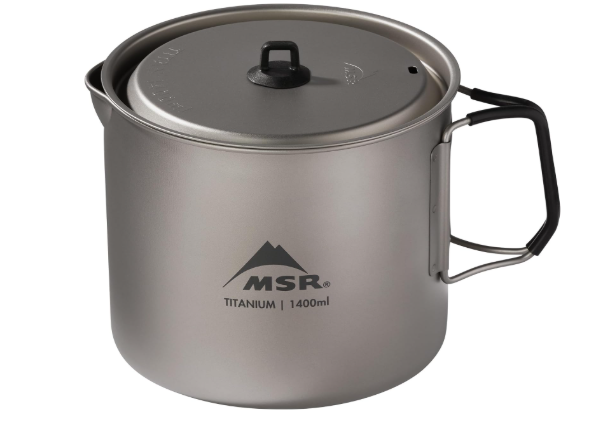
MSR Titan Kettle
- MaterialTitanium
- Capacity850 ml
- WeightAbout 4.1 oz
- FeaturesPour spout
Key features
- Titanium construction for minimal weight
- Pour spout for safer, cleaner pouring
- Strainer lid adds functional versatility
Pros
- Exceptionally light for backpacking
- Pour spout meaningfully improves everyday usability
- Highly durable titanium build
Cons
- Uneven heating is unsuited to anything beyond boiling water
- Costs more than comparable aluminum kettles
What we liked
- Exceptionally lightweight
- safer pouring
- highly durable
What we did not
- Uneven heating limits use to boiling
- pricier than aluminum
For backpackers who want the lightest practical kettle without sacrificing usability, this remains the top pick.
Check the current price2) Stanley Camp Kettle (Best for durability)
Stanley’s stainless steel kettle trades titanium’s weight advantage for genuine, long term durability, tolerating years of car camping abuse, dents, drops, and rough handling, without showing meaningful wear. Stainless steel also avoids the uneven heating pattern of titanium, spreading heat more evenly across the kettle body even though it heats up somewhat slower overall.
The added weight makes it a poor fit for backpacking, but for car camping, where weight is rarely the deciding factor, that trade is an easy one to accept in exchange for a kettle that will realistically outlast most other gear in your kitchen box.

Stanley Camp Kettle
- MaterialStainless steel
- Capacity1.5 liter
- WeightHeavy
- FeaturesWire handle
Key features
- Full stainless steel construction
- Wire handle for secure gripping
- Pour spout for controlled pouring
Pros
- Extremely durable, built to last for years
- More even heating than titanium
- Good capacity for a small group
Cons
- Too heavy for backpacking
- Slower to heat up than titanium or aluminum
What we liked
- Extremely durable
- even heating
- good small group capacity
What we did not
- Too heavy for backpacking
- slower heat up time
For car campers who want a kettle that will genuinely survive years of regular use, this remains the dependable choice.
Check the current price3) Sea to Summit X-Kettle (Best for packability)
The X-Kettle applies Sea to Summit’s collapsible design philosophy to this category, using food grade silicone walls over an aluminum base that still makes direct contact with the heat source for genuine heating performance. Collapsed, it packs down to a fraction of its working height, a real advantage for anyone trying to minimize bulk in a car camping kitchen box.
The aluminum base heats more evenly than titanium, while the silicone walls stay cool enough to grip without a potholder during use. The collapsible design costs more than a comparable rigid kettle and takes a trip or two to get used to handling confidently.

Sea to Summit X-Kettle
- MaterialSilicone walls
- Capacity1.3 liter
- WeightLight to moderate
- FeaturesCollapsible design
Key features
- Collapsible silicone walls over an aluminum base
- Cool to the touch grip during use
- Dramatically reduced packed height
Pros
- Best packed size of any kettle in this roundup
- Aluminum base delivers solid, even heating
- Cool silicone grip during use
Cons
- Higher price than a comparable rigid aluminum kettle
- Takes some getting used to handling confidently
What we liked
- Best in class packed size
- solid even heating
- cool grip
What we did not
- Higher price
- learning curve for handling
For campers with limited kitchen storage space who still want full kettle capacity, this solves that specific problem well.
Check the current price4) TOAKS Titanium Kettle (Best for groups going light)
TOAKS offers a larger capacity titanium kettle than the MSR option above, suited to backpacking groups who want to boil enough water for several people without carrying a heavier aluminum or stainless option. It retains titanium’s core weight advantage while scaling up to handle more demand per brew cycle.
Like any titanium vessel, heat concentrates directly under the flame rather than spreading evenly, so patience and attention during boiling matter more than with an aluminum kettle. For groups prioritizing total pack weight across several people’s gear, this remains an efficient way to share one larger, lighter vessel rather than carrying multiple smaller ones.
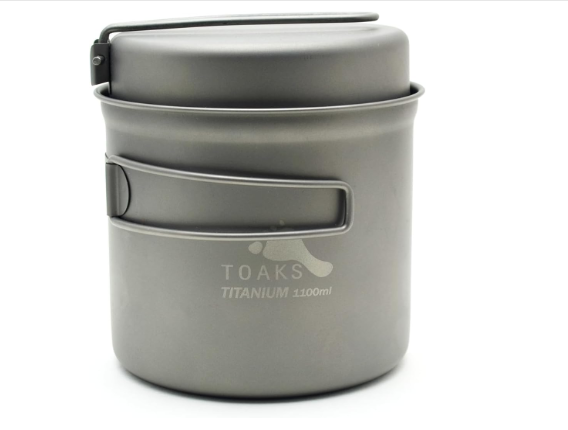
TOAKS Titanium Kettle
- MaterialTitanium
- Capacity1300 ml
- WeightAbout 5.9 oz
- FeaturesPour spout
Key features
- Larger titanium capacity for group use
- Pour spout for controlled pouring
- Folding handle for compact storage
Pros
- Good capacity to weight ratio for groups
- Durable titanium build
- Folding handle saves pack space
Cons
- Same uneven heating typical of titanium
- Pricier than a comparable aluminum kettle this size
What we liked
- Good group capacity to weight ratio
- durable
- saves pack space
What we did not
- Uneven heating
- pricier than aluminum
For backpacking groups who want to share one larger, lighter kettle rather than carrying several, this is the efficient choice.
Check the current price5) GSI Outdoors Glacier Kettle (Best for even heating)
The Glacier Kettle uses hard anodized aluminum, directly addressing titanium’s weak point in this category by spreading heat evenly across the entire base rather than concentrating it in one spot. A built in whistle alerts you the moment water reaches a boil, a genuinely useful feature when you are busy with other camp tasks and do not want to hover over the stove.
It runs heavier than the titanium options here but remains lighter than a full stainless steel kettle, landing in a sensible middle ground for campers who want even heating without the full weight penalty of steel. The whistle mechanism is one more part that could eventually need attention, though it rarely causes issues with normal use.

GSI Outdoors Glacier Kettle
- MaterialHard anodized aluminum
- Capacity1.8 liter
- WeightModerate
- FeaturesBuilt in whistle
Key features
- Hard anodized aluminum for even heat distribution
- Built in whistle alerts when water boils
- Moderate weight between titanium and stainless options
Pros
- Noticeably more even heating than titanium
- Whistle feature adds real convenience
- Reasonable weight to capacity ratio
Cons
- Heavier than the titanium options in this roundup
- Whistle mechanism is an extra part that could need attention over time
What we liked
- Even heating
- useful whistle feature
- reasonable weight
What we did not
- Heavier than titanium
- extra moving part
For campers who want even heating and a boil alert without going fully to stainless steel weight, this kettle hits that balance well.
Check the current priceFrequently asked questions
Is titanium or aluminum better for a camping kettle?
Titanium is lighter and more durable but heats less evenly, which matters little for simply boiling water. Aluminum heats more evenly and costs less, making it the better choice if the kettle will also see any actual cooking duty rather than pure boiling.
Do I need a whistle on a camping kettle?
A whistle is a convenience feature rather than a necessity, useful if you want to step away from the stove while water heats. Without one, you simply need to keep an eye or ear on the kettle as it approaches a boil.
Can a camping kettle go directly on a campfire?
Stainless steel and most hard anodized aluminum kettles tolerate direct flame reasonably well, though titanium kettles with thin walls can develop hot spots that scorch any residue inside. Always check the manufacturer’s guidance for direct flame use.
How much water capacity do I need for a group?
A good rule of thumb is roughly 300 to 500 milliliters of boiling water capacity per person for hot drinks or dehydrated meals, meaning a four person group is generally well served by a kettle in the 1.3 to 1.8 liter range.
Conclusion
For most backpackers, the MSR Titan Kettle remains the easiest overall recommendation, combining genuine weight savings with the pour spout usability that basic titanium pots lack. Car campers who prioritize long term durability should look to the Stanley Camp Kettle instead, accepting the extra weight for a kettle that will last for years.
Campers short on kitchen storage space should consider the Sea to Summit X-Kettle for its collapsible design, while groups going lightweight together should look at the larger capacity TOAKS Titanium Kettle. For related gear, see our camping coffee makers roundup, and our titanium cookware for backpacking guide covers more of this material’s trade offs in depth.
Buy the MSR Titan Kettle for the best overall backpacking balance, the Stanley Camp Kettle if you need years of car camping durability, and the Sea to Summit X-Kettle if packed space is your biggest constraint.