The best tent for camping in high wind depends far more on frame design and guyline systems than on capacity or price, since a large family tent with weak poles can fail in gusts that a well-engineered smaller tent shrugs off easily. Low profiles, reinforced pole hubs, and full guyline coverage all matter more in wind than any marketing claim about weather rating. This roundup covers five tents built with real wind resistance in mind. For the wider category, our family camping tents buying guide covers calmer-weather options too.
1. Gazelle T4 Hub Tent
The Gazelle T4’s aircraft-grade aluminum hub frame flexes under gusts and springs back rather than bending permanently, making it one of the most wind-resistant designs available at this capacity.
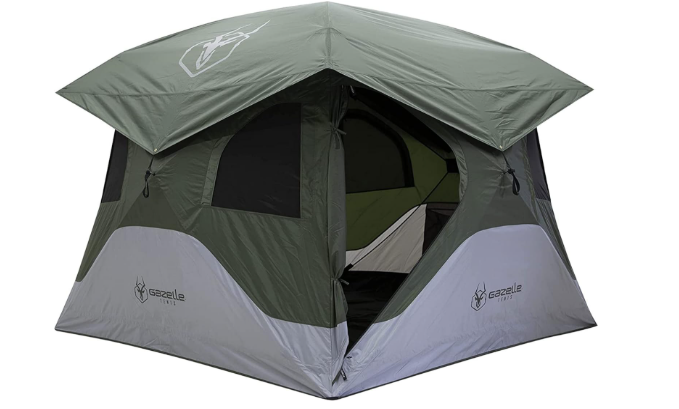
Gazelle T4 Hub Tent
- Capacity4 person
- FrameAircraft-grade aluminum hub
- Setup timeUnder 2 minutes
- Season rating3 season
Key features:
- Aircraft-grade aluminum hub frame
- Low, freestanding profile reduces wind resistance
- Multiple guy points for additional stability
Pros:
- Frame flexes and recovers rather than bending permanently in gusts
- Low profile presents less surface area to catch wind
- Fast setup, useful when weather is closing in quickly
Cons:
- Smaller capacity than larger cabin-style family tents
- Premium price for the hub-style construction
What we liked
- Excellent frame flex
- low wind-catching profile
- fast setup
What we did not
- Smaller capacity
- premium price
For the best overall wind resistance, the Gazelle T4’s frame design stands out in this comparison.
Check Price on Amazon2. Eureka Copper Canyon LX 6
The Copper Canyon LX 6 uses a steel and fiberglass hybrid pole structure that adds real stability to a cabin-style tent, a category that typically struggles more in wind than lower dome designs.

Eureka Copper Canyon LX 6
- Capacity6 person
- FrameSteel and fiberglass hybrid
- Center height6.2 ft
- Season rating3 season
Key features:
- Steel and fiberglass hybrid pole structure
- Full-coverage rainfly with reinforced guy points
- Near-vertical cabin walls with standing headroom
Pros:
- Strong wind resistance despite the tall cabin profile
- Reinforced guy points hold tension well in gusts
- Standing headroom without sacrificing structural stability
Cons:
- Heavier and bulkier than dome-style alternatives
- Setup takes longer due to the more complex pole structure
What we liked
- Strong wind resistance
- reinforced guy points
- standing headroom
What we did not
- Heavier
- longer setup
Families who want cabin-style comfort without giving up wind stability should look to the Copper Canyon LX 6.
Check Price on Amazon3. Kodiak Canvas Flex-Bow 6
The Flex-Bow 6 uses a flexible steel bow frame specifically designed to bend and recover under wind load rather than snapping, a design borrowed from more demanding expedition tents.
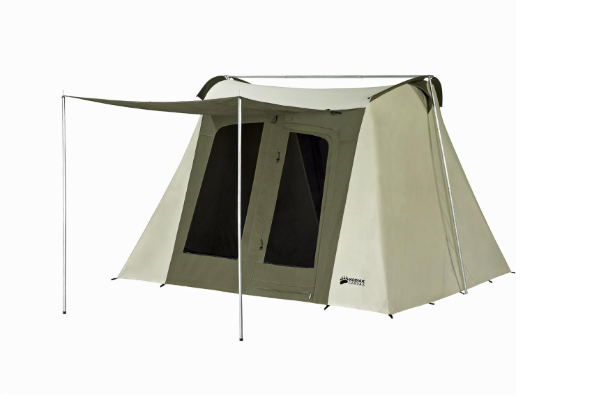
Kodiak Canvas Flex-Bow 6
- Capacity6 person
- FrameFlexible steel bow
- Fabric10oz cotton canvas
- Season rating3 season
Key features:
- Flexible steel bow frame flexes under wind load
- 10-ounce cotton canvas construction
- Awning-style door with reinforced guy points
Pros:
- Steel bow frame flexes and recovers rather than bending permanently
- Canvas construction adds durability against sustained wind and rain
- Frame holds up over years of repeated storm exposure
Cons:
- Heaviest option in this comparison by a wide margin
- Canvas requires more maintenance than synthetic fabrics
What we liked
- Excellent frame flex
- durable canvas
- long-term storm resistance
What we did not
- Very heavy
- needs canvas care
Families who camp in genuinely unpredictable wind regularly should consider the long-term durability of the Flex-Bow 6.
Check Price on Amazon4. NTK Colorado GT 6
The Colorado GT 6 punches above its price for wind protection, using steel-reinforced fiberglass poles at a fraction of the cost of premium hub or canvas designs.

NTK Colorado GT 6
- Capacity6 person
- FrameFiberglass with steel reinforcement
- Center height5.4 ft
- Season rating3 season
Key features:
- Fiberglass poles with steel reinforcement at stress points
- Full-coverage rainfly with taped seams
- Reinforced guy points for added stability
Pros:
- Strong wind protection relative to price
- Steel-reinforced poles add stability without a premium cost
- Full rainfly coverage handles sustained rain alongside wind
Cons:
- Less brand recognition than Coleman or Eureka
- Interior organization features are minimal
What we liked
- Strong wind protection
- reinforced poles
- good value
What we did not
- Less brand recognition
- minimal organization
Budget-conscious families who still want real wind protection should give the Colorado GT 6 serious consideration.
Check Price on Amazon5. REI Co-op Wonderland 6
The Wonderland 6 uses an especially thorough guyline system, giving it more anchor points than most family tents and letting you distribute wind load across the entire structure.

REI Co-op Wonderland 6
- Capacity6 person
- FrameAluminum pole with guyline system
- Center height6.2 ft
- Season rating3 season
Key features:
- Aluminum pole structure with extensive guyline points
- Full-coverage rainfly with reinforced tie-outs
- Near-vertical walls for standing room
Pros:
- Extensive guyline coverage distributes wind load effectively
- Backed by REI’s dependable warranty and customer service
- Aluminum poles resist bending better than basic fiberglass
Cons:
- Higher price than budget-focused competitors
- Setting up all the guylines properly takes extra time
What we liked
- Extensive guyline coverage
- dependable warranty
- sturdy aluminum poles
What we did not
- Higher price
- more setup time
Families who want maximum stability from a thorough guyline system should consider the Wonderland 6.
Check Price on AmazonFAQ
What matters most for wind resistance in a family tent?
Pole material and structure matter most, followed by a low profile and a full set of properly staked guylines. Capacity and price are far less predictive of wind performance.
Should I stake out every guy point in high wind?
Yes, using all available guy points significantly improves stability, even on tents rated for moderate weather, and it is one of the simplest ways to improve wind performance for free.
Are dome tents more wind-resistant than cabin tents?
Generally yes, since their lower, curved profile presents less surface area to catch wind, though well-engineered cabin tents like the Copper Canyon LX 6 can still perform well.
Can canvas tents handle wind as well as synthetic ones?
Canvas tents like the Kodiak Flex-Bow often perform excellently in wind due to their flexible steel frames, though they are significantly heavier than synthetic alternatives.
Conclusion
Wind resistance comes down to frame engineering and guyline coverage far more than capacity or price, and the five tents here each approach that challenge differently. The Gazelle T4 leads on pure frame flexibility, while the Copper Canyon LX 6 proves cabin-style comfort and wind stability are not mutually exclusive.
The Gazelle T4 Hub Tent is the best overall tent for camping in high wind, with the Eureka Copper Canyon LX 6 as the top cabin-style pick and the Kodiak Canvas Flex-Bow 6 offering the best long-term storm durability.