
Knowing how to choose a campsite is the skill that separates a weekend you want to repeat from one you spend enduring. The pitch decides how well you sleep, whether you stay dry when the weather turns, how much wind you take through the night, and whether you wake to a view or to the back of somebody’s caravan.
Most people choose on appearance, which is understandable and usually wrong. The best looking spot is frequently the worst place to sleep, because the things that make a site pleasant at four in the afternoon are not the things that matter at four in the morning. Here is what experienced campers actually look at, in the order they check it.
The short answer
Look for flat, well drained ground on slightly raised terrain, sheltered from prevailing wind but not directly beneath trees. Avoid hollows where cold air and water collect, and avoid the very top of exposed rises. Check what is overhead, stay well back from water, and think about where the sun will rise. At a managed campground, prioritise distance from the toilet block and the main path over the view.
Start with the ground itself
Everything else is negotiable. The surface you sleep on is not, because you cannot fix it once the tent is up and dark has fallen.
- Flat comes first. Not nearly flat. Lie down and check, because the eye is poor at reading slope and the body is excellent at it. If you must have a slope, sleep with your head uphill.
- Drainage beats softness. Lush, soft grass often means the ground holds water. Slightly raised, firmer ground stays dry when it rains overnight.
- Avoid hollows and depressions. Cold air sinks into them and so does rainwater. A dip that looks sheltered at dusk is the coldest, wettest spot on the site by dawn.
- Clear it properly. Stones and roots you barely notice underfoot become impossible to ignore under a sleeping pad.
- Check the surface can hold a peg. Hard packed gravel and loose sand both cause problems, and you want to discover that before the fly is on.
Read the wind and the trees
Wind is the thing most likely to turn a comfortable night uncomfortable, and trees are the thing most likely to be genuinely dangerous. They interact, which is why they belong together.
Look for partial shelter rather than either extreme. An exposed ridge or hilltop takes the full force of anything that comes through overnight. A dense thicket gives shelter but traps damp air and drips on you for hours after the rain has stopped. The sweet spot is usually the lee side of a natural feature, a little way back from it, with some tree cover nearby but not directly overhead.
Then look up, properly, before you commit. Dead branches in the canopy are the reason experienced campers glance skyward at every pitch. They come down in wind with no warning. Avoid pitching under a tree that has obvious dead limbs, leaning trunks or recent deadfall on the ground around it, because the deadfall tells you what that tree does.
Once the site is chosen, pitching with the narrowest end of the tent facing the wind and guying it properly does the rest. Our guide to how to keep a tent dry in heavy rain covers the pitching side.
Water, near enough but not too near
Being close to a stream or lake is convenient and pleasant, and pitching right on the bank is a mistake for four separate reasons.
- Water levels rise. Rain upstream arrives hours later and campers have been caught out by streams that looked harmless the previous evening.
- Cold air pools along water. A bankside pitch is noticeably colder overnight than one a short walk away.
- Insects concentrate there, particularly at dawn and dusk.
- It is the wildlife corridor. Animals come to drink, and you do not want your tent on their route.
Most backcountry guidance suggests camping at least seventy metres from water, which also protects the bank from erosion and keeps washing away from the source. Close enough to collect water easily, far enough to avoid all four problems.
Think about tomorrow morning
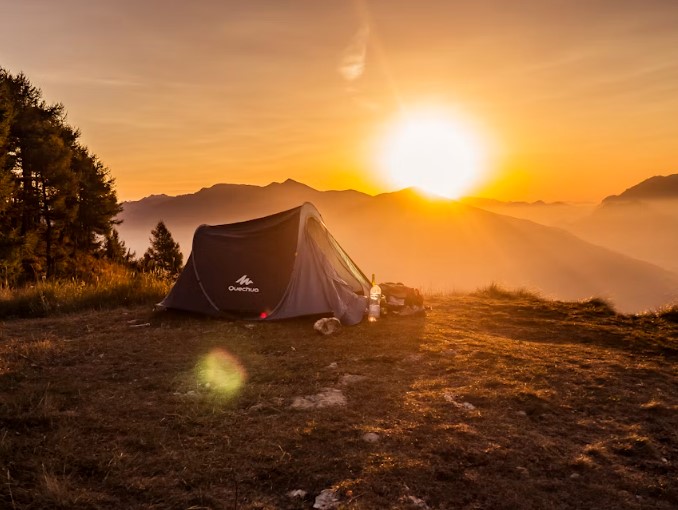
A site chosen only for tonight ignores half the experience. Work out roughly where the sun will come up, because a tent facing east becomes an oven shortly after dawn in summer and a welcome warm spot in winter. Choose the orientation deliberately rather than by accident.
Consider shade for the middle of the day if you plan to be at the site, and consider where you will cook. A sheltered flat area a few steps from the tent makes cooking easier and keeps food smells away from where you sleep, which matters more in bear country than anywhere else.
Choosing a pitch at a managed campground
The criteria shift when the ground is already flat and somebody else has decided where the sites are. Here the variables are mostly about people.
- Distance from the toilet block. Close is convenient and means footsteps past your tent all night. Two or three sites away is the usual compromise.
- Not on the main path or the loop road, where headlights sweep across the tent every time somebody arrives.
- Check what is upwind. Fire smoke and cooking smells travel, and so does the sound from a large group.
- Look at your neighbours before booking a specific pitch if you can. A quiet corner next to a family reunion is not a quiet corner.
- Corner and end sites usually have fewer neighbours and more space, which is why regulars book them first.
Once you are settled in, our note on campground etiquette rules covers being the neighbour everyone else hoped for.
Common mistakes
- Choosing the view over the ground. The outlook matters for an hour in the evening. The ground matters for eight hours in the dark.
- Pitching in a dip because it looks sheltered. It is sheltered from wind and it collects cold air and water. A slightly raised spot with partial wind cover beats it every time.
- Not looking up. The single check most likely to matter and the one most consistently skipped. It takes five seconds.
- Committing before walking the area. Two minutes spent checking three candidate spots is the cheapest improvement available to any camper. Once the tent is up, nobody moves it.
Frequently asked questions
How far from water should you camp?
Around seventy metres is standard guidance in most backcountry areas, and some places set their own minimum. It keeps you clear of rising water, out of the cold air that pools along banks, away from the worst of the insects, and off the route wildlife uses to drink.
Should I camp on high ground or low ground?
Slightly raised ground, but not the top of an exposed rise. Low hollows collect cold air and rainwater, while summits take the full force of the wind. Partway up a gentle slope, with some natural shelter on the windward side, is usually the best compromise.
Which way should my tent face?
Put the narrowest end into the prevailing wind so the tent sheds it rather than catching it. Beyond that, face the door away from where the sun rises if you want to sleep in, and towards it in cold weather when early warmth is welcome.
Is it bad to camp under trees?
Partial cover nearby is good, and directly underneath is risky. Dead branches fall in wind without warning, and tree cover keeps dripping long after rain stops. Look up before pitching and avoid any tree with dead limbs, a lean or fresh deadfall beneath it.
Wrapping up
How to choose a campsite comes down to checking things in the right order. Ground first, since you cannot fix it later. Then wind and what is overhead. Then distance from water, then which way the sun will arrive. The view is the last consideration, not the first, however tempting it is to reverse that.
The habit worth forming is walking the area and lying down on the ground before the tent comes out of the bag. It takes two minutes and it prevents most of the problems described above.
For the rest of the basics, see our guide to camping for beginners, and how to sleep better in a tent covers what to do once the pitch is chosen.