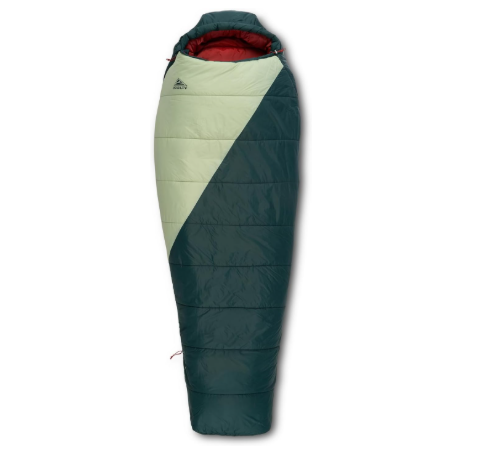
This Kelty Cosmic 20 review looks at a synthetic mummy bag that has become a default recommendation for backpackers who want three season warmth without paying down bag prices. It is built for hikers and campers who want a dependable, budget friendly bag that still performs when it gets damp inside a tent, which is where synthetic fill earns its keep over down.
The Cosmic 20 is not trying to be the lightest or most packable bag on the trail. It is trying to be the bag that keeps working trip after trip without babying, and for most three season backpackers that trade off makes more sense than it first appears once you actually account for how differently synthetic and down insulation behave in the field rather than on a spec sheet.
Specifications
| Temperature rating | 20°F |
| Fill type | Synthetic (Cloudloft) |
| Weight | 3 lb 3 oz (regular) |
| Packed size | 8 x 16 in |
| Shape | Mummy |
| Liner fabric | Polyester taffeta |
Who it is for
This bag suits three season backpackers and car campers who want one bag that can handle a chilly fall night without needing careful storage or dry bag babysitting the way a down bag does. It is a strong fit for newer backpackers who have not yet learned to keep a down bag bone dry every single trip, since synthetic fill keeps insulating even when it picks up condensation off a tent wall. Scout leaders, outdoor education instructors, and anyone loaning gear out to friends or family also tend to gravitate toward this bag specifically because it survives the kind of imperfect handling that a rental fleet or a shared gear closet inevitably produces.
It is a weaker fit for anyone hiking serious mileage where every ounce in the pack matters, since synthetic insulation cannot match down for warmth per pound. Thru hikers, fastpackers, and anyone doing multi week trips where pack weight compounds daily will generally find the weight and bulk penalty adds up in a way that erodes the price advantage over the course of a long trip. It is also a less natural choice for anyone who already owns and trusts a down bag and simply wants to shave weight, since the whole appeal of the Cosmic 20 is built around forgiveness rather than performance ceiling.
How it performs
Warmth
At its rated temperature the Cosmic 20 performs close to what the number promises for an average sleeper, with the hood and draft collar doing real work to seal in warmth around the neck and shoulders. Cold sleepers will likely want to treat the rating as a comfort limit rather than a survival limit, which is true of most 20 degree bags regardless of brand. Industry testing under the EN/ISO 23537 standard, the lab protocol most major manufacturers now use, actually produces two separate numbers rather than one: a comfort rating meant for a relaxed, average cold sleeper and a lower limit rating meant for a warm sleeper curled in a more insulating position. Brands often print only one number on the hangtag, so it is worth knowing that the printed rating on a bag like this is closer to the limit figure than the comfort figure for most people.
Approaching the rated 20 degrees, the bag performs reliably as long as it is paired with an insulated pad, since a thermal manikin test measures the bag in isolation and does not account for ground cold bleeding up through an uninsulated sleeping surface. Push conditions ten or more degrees below the rating and the gap between marketing number and lived experience widens noticeably, with drafts around the hood cinch and the zipper becoming the main source of heat loss rather than any flaw in the fill itself. Layering a base layer or adding a liner extends the comfortable range by several degrees without needing to buy a second bag.
Comfort and fit
The mummy cut is roomier through the shoulders and hips than some ultralight competitors, which makes it a reasonable choice for side sleepers who shift position through the night. The liner fabric feels soft against skin and does not trap heat the way some budget synthetics do, which matters more than it sounds since a scratchy or overly warm liner is a common complaint on inexpensive bags that cut corners on the interior fabric specifically to save cost on the insulation instead.
The hood uses a simple drawcord cinch rather than a two stage collar and hood system found on pricier bags, and it does a competent job sealing around the face once you learn how tight to pull it, though it takes a trip or two to find the right cinch point without leaving a gap at the crown of the head. The draft collar, a separate insulated tube that sits at the shoulders and blocks the bellows effect of warm air pumping out through the neck opening every time you shift, is a detail some bags at this price skip entirely, and its presence here is a meaningful part of why the Cosmic 20 performs closer to its rating than many competitors.
Compressibility
This is the bag’s weakest point. Synthetic fill simply does not compress as small as down, and the Cosmic 20 takes up noticeably more room in a pack than a comparable down bag like the Kelty Galactic. This comes down to the physical structure of the insulation itself: down clusters trap air in a three dimensional web that collapses and re-expands efficiently, while synthetic fiber, whether short staple or continuous filament, is bulkier by nature and needs more raw material by weight to trap the same amount of air, which is also why fill power, a measurement of how many cubic inches one ounce of down occupies when fully lofted, does not apply to synthetic insulation at all.
Anyone packing light for a multi day trip should budget extra space for it, generally planning on the Cosmic 20 taking up close to a third more pack volume than an equivalently rated down bag. Over a season of repeated stuff sack cycles, synthetic fill also tends to lose a small amount of loft faster than a quality down fill would, though the Cosmic 20’s Cloudloft fill is specifically engineered to resist this fatigue better than the cheapest synthetic fills on the market, and most owners report the bag still lofting well after a full season of regular compression.
Durability
The synthetic fill holds its loft well over repeated compression cycles, and it shrugs off the occasional damp night or careless stuff sack job that would leave a down bag clumped and cold. This durability under imperfect care is the strongest argument for choosing it over a down alternative. Down, when it gets wet, loses its loft almost entirely as the individual plumes stick together into cold, heavy clumps that can take days of sustained sun and airflow to fully dry out in the field, while synthetic fiber retains a meaningful amount of its structure and trapped air even when soaked through, and dries substantially faster on a clothesline or draped over a pack the next morning.
The shell fabric on the Cosmic 20 also handles overnight condensation reasonably well, an unavoidable reality of sleeping in an enclosed tent where exhaled moisture collects on cold fabric surfaces. A light dusting of condensation on the shell wipes off or air dries quickly without soaking through to the fill, though a genuinely wet night against the tent wall will eventually saturate the outer layer if the bag is left in contact with it for hours. Over several seasons the shell has proven resistant to the kind of pilling and abrasion that shows up first on cheaper synthetic bags, particularly around the footbox where feet push against the fabric repeatedly.
Fit and cut
Kelty cuts the Cosmic line with a moderately generous mummy taper rather than the trim, efficiency focused cut found on premium ultralight bags, and that choice shows up directly in how the bag lives day to day. There is enough room through the hips and knees to draw them up slightly or roll partially onto a side without the fabric pulling taut across the body, which is the single biggest factor in whether a mummy bag feels claustrophobic to a given sleeper. The footbox is boxed rather than tapered to a point, giving feet a bit more room to sit naturally rather than being forced into a pointed wedge shape.
The bag also uses a differential cut, meaning the outer shell fabric is cut slightly larger than the inner liner fabric so the insulation between them is not compressed flat when the bag curves around the body’s contours. Without this construction detail, insulation gets pinched thin exactly where the body pushes against the fabric, undermining loft in precisely the areas that most need it. It is a small manufacturing choice that does not show up on a spec sheet but matters considerably for real world warmth.
Pros and cons
What we liked
- Performs reliably even when damp
- roomy mummy cut
- holds loft well over years of use
- budget friendly compared to down options
What we did not
- Bulkier packed size than down competitors
- heavier than similarly rated down bags
How it compares
Against the Marmot Trestles Elite Eco 20, the Cosmic 20 packs down slightly smaller and uses a fill engineered specifically to resist compression fatigue, while the Trestles Elite Eco leans further into sustainable, recycled materials at a similar price point and offers a noticeably warmer footbox. Neither bag has a clear performance edge over the other at the rated temperature, so the choice largely comes down to whether recycled materials or marginal pack size matters more to a given buyer.
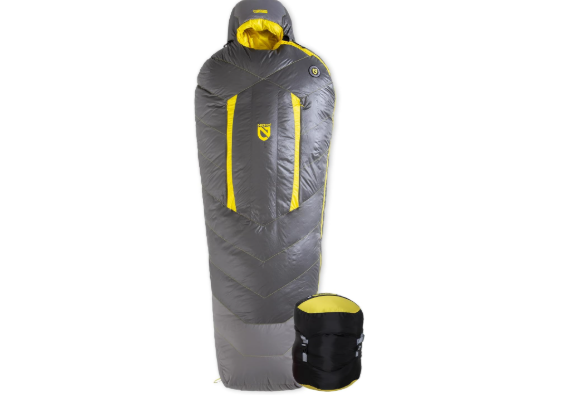
Against the Kelty Galactic 30, the Cosmic 20 is rated for meaningfully colder nights but gives up real packability, since the Galactic uses down fill to trade some warmth for a lighter, more compressible build better suited to summer trips and backpackers who prioritize pack space. Anyone who splits their camping between spring, fall, and genuinely cold nights should lean toward the Cosmic 20, while summer focused campers will likely find the Galactic’s lighter build more practical.
Against the REI Co-op Magma 15, the Cosmic 20 is far more affordable and considerably more forgiving of moisture, but it cannot come close to matching the Magma’s warmth to weight ratio or its remarkably small packed size, since 850 fill power down simply outperforms any synthetic fill on those two specific metrics. Backpackers logging serious mileage who can afford the premium price and are willing to manage down’s moisture sensitivity will get more bag for the ounce with the Magma, while everyone else will likely find the Cosmic 20’s durability and price the more practical choice.
Frequently Asked Questions
Is the Kelty Cosmic 20 good for beginners?
Yes, it is a common first backpacking bag recommendation because the synthetic fill forgives the storage and drying mistakes that new backpackers tend to make with down bags.
Can the Kelty Cosmic 20 get wet without losing warmth?
It handles dampness far better than a down bag, since synthetic insulation keeps trapping air even when partially wet, though it should still be dried out fully when possible to protect the fabric over time.
How does the Kelty Cosmic 20 pack down compared to a down bag?
It packs noticeably larger than a similarly rated down bag, which is the main trade off for choosing synthetic fill, so plan for extra pack volume if you go this route.
Is 20 degrees warm enough for three season camping?
For most spring, summer, and fall trips in temperate regions, yes, though anyone who sleeps cold or camps at higher elevation should treat the rating as a comfort limit and consider layering with a liner on colder nights.
Verdict
The Kelty Cosmic 20 earns its long running popularity by doing the unglamorous things well. It keeps insulating when it gets damp, holds its loft over years of use, and fits a wider range of body types comfortably than many mummy bags in its price range. It is not the bag to buy if pack weight is your top priority, and the compressibility gap compared to down only grows more noticeable the more seriously you take backpacking mileage.
Buy this if you want a dependable three season bag that will not punish you for an imperfect drying routine and you are not chasing the smallest possible pack size. Look elsewhere, toward a down option like the Western Mountaineering UltraLite or the REI Co-op Magma 15, if shaving weight and packed size matters more to you than budget and forgiveness. For a broader look at how this bag stacks up against the rest of the category, our sleeping bags guide covers the full range.
A dependable, forgiving synthetic mummy bag that keeps performing even when it gets damp, ideal for beginners and anyone who prioritizes reliability over pack weight.